Introduction
Human rights are moral principles that describe certain standards of human behavior and are regularly protected as natural and legal rights. According to the UN, human rights are rights inherent to all human beings regardless of race, sex, nationality, ethnicity, language, religion, or any other status. These rights include the right to life and liberty, freedom from slavery and torture, freedom of expression, the rights to work, education, and many more. Everyone is entitled to these rights without discrimination.
This analysis provides a comparative and critical examination of human rights as granted by Islam and those enshrined in the Universal Declaration of Human Rights (UDHR, 1948) , highlighting their foundations, strengths, limitations, and areas of convergence and divergence.
Part I: Historical Development of Human Rights
Key Milestones in Western Human Rights
| Era | Development | Limitation |
|---|---|---|
| Cyrus Cylinder (539 BC) | Freed slaves, right to choose religion, racial equality | Early foundation but not universally applied |
| Greece | Rights for free, adult, Greek men only | Excluded women, children, elderly, non-Greeks |
| Rome | Rights for Roman citizens | Women had fewer limitations but still excluded |
| Magna Carta (1215) | First formal human rights document in England | Applied primarily to nobility |
| Enlightenment (16th C) | Dignity and equal rights for all people | Theoretical; slow implementation |
| Secularisation | Separation of religion from state | Church excluded from state affairs |
| Declaration of Independence (1776/89) | Formal human rights recognition | Slavery persisted for nearly a century |
| UDHR (1948) | Universal framework for human rights | Post-WWII response to atrocities |
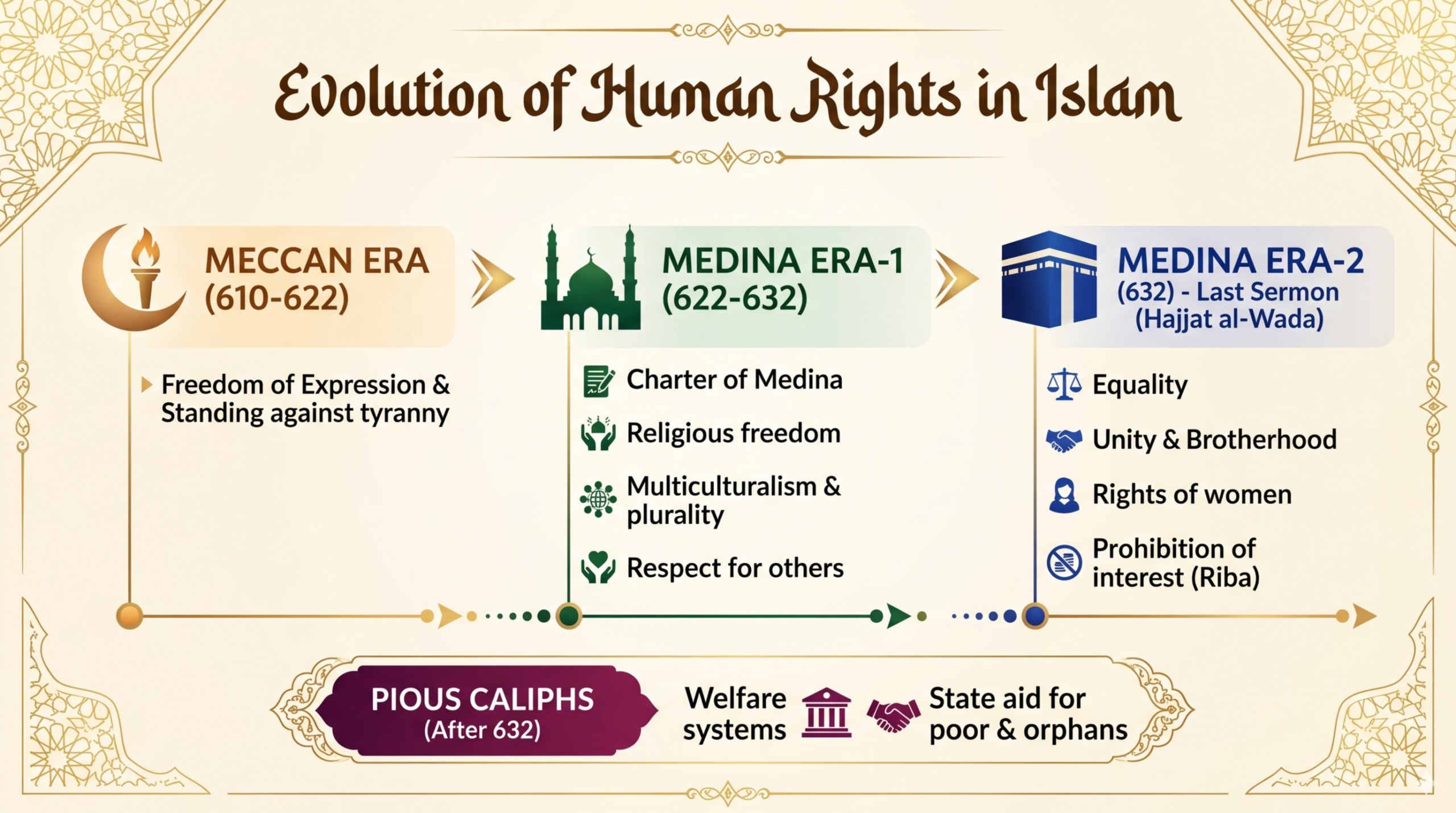
Human Rights in Islam: A Timeline
Part II: Fundamental Differences in Foundation
Comparison of Sources and Authority
| Aspect | Islam | UDHR (Western) |
|---|---|---|
| Source | Divine revelation (Quran and Sunnah) | Human reason, historical experience, consensus |
| Authority | Allah SWT | Nation-states and international bodies |
| Amendability | Inalienable and unchangeable | Amendable by human consensus |
| Sanction | Divine accountability (Hereafter) | Legal and political accountability |
| Scope | Comprehensive (Dunya and Akhirah) | Secular (this world only) |
Critical Insight
“The rights in Islam are divine and no one can amend them or take them away from others. These rights are inalienable and bestowed upon humans in the Quran.”
This stands in contrast to Western human rights, which are amendable by humans. As noted in the content: “While the laws are made by humans, they are also amendable by them. Everyone who has enough support can amend the law.”
Example of Amendability: *”In an earlier time in the west, there were no concepts of same-gender relationships. Now they have allowed LGBTQ. Amendment in abortion rights in half of the US states in 2022 that was recognized as liberty rights for women in 1973.”*
Part III: Comparative Analysis of Specific Rights
1. Right to Life
| Aspect | Islam | UDHR (Article 3) |
|---|---|---|
| Foundation | Divine command | Inherent human dignity |
| Scope | All human life | All human beings |
| Protection | “Whoever takes a life—unless as a punishment for murder or mischief in the land—it will be as if they killed all of humanity” [5:32] | Everyone has the right to life, liberty, and security |
Islamic Verse:
مَن قَتَلَ نَفْسًۢا بِغَيْرِ نَفْسٍ أَوْ فَسَادٍۢ فِى ٱلْأَرْضِ فَكَأَنَّمَا قَتَلَ ٱلنَّاسَ جَمِيعًۭا وَمَنْ أَحْيَاهَا فَكَأَنَّمَآ أَحْيَا ٱلنَّاسَ جَمِيعًۭا
“Whoever takes a life—unless as a punishment for murder or mischief in the land—it will be as if they killed all of humanity; and whoever saves a life, it will be as if they saved all of humanity.” [Surah Al-Ma’idah: 5:32]
Critical Comparison:
- Both systems affirm the sanctity of life
- Islam provides divine sanction for protecting life
- UDHR relies on secular legal frameworks
2. Freedom of Religion
| Aspect | Islam | UDHR (Article 18) |
|---|---|---|
| Quranic Basis | “You have your way, and I have my Way” [109:6] “Let there be no compulsion in religion” [2:256] | Everyone has the right to freedom of thought, conscience, and religion |
| Scope | Complete religious freedom for non-Muslims under Islamic rule | Universal freedom of religion |
Islamic Verses:
لَكُمْ دِينُكُمْ وَلِيَ دِينِ
“You have your way, and I have my Way.” [Surah Al-Kafirun: 109:6]
لَا إِكْرَاهَ فِي الدِّينِ
“Let there be no compulsion in religion, for the truth stands out clearly from falsehood.” [Surah Al-Baqarah: 2:256]
Critical Analysis:
| Dimension | Islamic Approach | UDHR Approach |
|---|---|---|
| Source | Divine command | Human rights framework |
| Implementation | Historical precedent (Charter of Medina) | Contemporary legal systems |
| Limitations | Within Islamic state structure | Subject to national laws |
3. Justice and Fair Trial
| Aspect | Islam | UDHR (Articles 7-11) |
|---|---|---|
| Quranic Basis | “And if two groups of believers fight each other, then make peace between them… act justly. Surely Allah loves those who uphold justice.” [49:9] | Right to equality before law, fair trial, presumption of innocence |
| Principle | Justice even against those you hate | Universal justice |
Islamic Verse:
وَإِن طَائِفَتَانِ مِنَ الْمُؤْمِنِينَ اقْتَتَلُوا فَأَصْلِحُوا بَيْنَهُمَا ۖ فَإِن بَغَتْ إِحْدَاهُمَا عَلَى الْأُخْرَىٰ فَقَاتِلُوا الَّتِي تَبْغِي حَتَّىٰ تَفِيءَ إِلَىٰ أَمْرِ اللَّهِ ۚ فَإِن فَاءَتْ فَأَصْلِحُوا بَيْنَهُمَا بِالْعَدْلِ وَأَقْسِطُوا ۖ إِنَّ اللَّهَ يُحِبُّ الْمُقْسِطِينَ
“And if two groups of believers fight each other, then make peace between them. But if one of them transgresses against the other, then fight against the transgressing group until they submit to the rule of Allah. If they do so, then make peace between both groups in all fairness and act justly. Surely Allah loves those who uphold justice.” [Surah Al-Hujurat: 49:9]
Key Islamic Principle: Innocent Until Proven Guilty
“In Islam, a person is innocent and cannot be called guilty or worthy of punishment until he is proven guilty.”
4. Equality Before Law
| Aspect | Islam | UDHR (Article 7) |
|---|---|---|
| Quranic Basis | “Do not let the hatred of a people lead you to injustice. Be just! That is closer to righteousness.” [5:8] | All are equal before the law |
Islamic Verse:
وَلَا يَجْرِمَنَّكُمْ شَنَـَٔانُ قَوْمٍ عَلَىٰٓ أَلَّا تَعْدِلُوا۟ ۚ ٱعْدِلُوا۟ هُوَ أَقْرَبُ لِلتَّقْوَىٰ
“Do not let the hatred of a people lead you to injustice. Be just! That is closer to righteousness.” [Surah Al-Ma’idah: 5:8]
Last Sermon Declaration:
“All mankind is from Adam and Eve, an Arab has no superiority over a non-Arab nor does a non-Arab has any superiority over an Arab; also, a white has no superiority over a black, nor a black has any superiority over a white—except by piety and good action.” [Hadith]
5. Right to Protest
| Aspect | Islam | UDHR (Article 20) |
|---|---|---|
| Quranic Basis | “Allah does not like negative thoughts to be voiced except by those who have been wronged.” [4:148] | Right to peaceful assembly and association |
Islamic Verse:
لَّا يُحِبُّ اللَّهُ الْجَهْرَ بِالسُّوءِ مِنَ الْقَوْلِ إِلَّا مَن ظُلِمَ
“Allah does not like negative thoughts to be voiced except by those who have been wronged.” [Surah An-Nisa: 4:148]
Historical Precedent:
“We learn the freedom of expression from Rasool Allah and his companions that how he preached Islam and raised voices against tyranny after having a few people. His uncle, Abu Talib defended Rasool Allah from many kinds of torture.”
6. Right to Privacy and Protection from Backbiting
| Aspect | Islam | UDHR (Article 12) |
|---|---|---|
| Quranic Basis | “Avoid suspicions… do not spy, nor backbite one another. Would any of you like to eat the flesh of their dead brother?” [49:12] | No arbitrary interference with privacy |
Islamic Verse:
يَا أَيُّهَا الَّذِينَ آمَنُوا اجْتَنِبُوا كَثِيرًا مِّنَ الظَّنِّ إِنَّ بَعْضَ الظَّنِّ إِثْمٌ ۖ وَلَا تَجَسَّسُوا وَلَا يَغْتَب بَّعْضُكُم بَعْضًا ۚ أَيُحِبُّ أَحَدُكُمْ أَن يَأْكُلَ لَحْمَ أَخِيهِ مَيْتًا فَكَرِهْتُمُوهُ
“O believers! Avoid any suspicions, for indeed, some suspicions are sinful. And do not spy, nor backbite one another. Would any of you like to eat the flesh of their dead brother? Surely you would hate that.” [Surah Al-Hujurat: 49:12]
Part IV: Critical Problems with Western Human Rights
A. When Human Rights Work: Individualism Over Community
| Issue | Description |
|---|---|
| Individualistic Focus | “In the west, human rights are mostly individually focused which in turn causes society to suffer. Individual rights are very prominent.” |
| Self-Motives | “Preferences towards self-motives are higher in the west as western people easily sacrifice family and social rights.” |
| Example | “They can marry and divorce whenever they want.” |
| Rights Without Responsibilities | “People have many human rights in the west, but they do not have responsibilities. It is about only getting human rights and not giving them back.” |
B. When Human Rights Do Not Work
┌─────────────────────────────────────────────────────────────────────────────────────┐
│              FAILURES OF HUMAN RIGHTS IN WESTERN CONTEXT                            │
├─────────────────────────────────────────────────────────────────────────────────────┤
│                                                                                      │
│   Holocaust      Vietnam War    Iraq Invasion    Bosnian        Quran Burning      │
│   (Germany)      (Mass          (2003)           Genocide       (Sweden)          │
│                 Destruction)                     (1990s)                          │
│        │              │               │              │               │            │
│        └──────────────┴───────────────┴──────────────┴───────────────┘            │
│                                        │                                            │
│                                        ▼                                            │
│                      "Western countries and people do not follow                    │
│                       human rights in conflicts, wars, and in                       │
│                       freedom of expression."                                       │
│                                                                                      │
└─────────────────────────────────────────────────────────────────────────────────────┘
C. Irregularity in Application
“Implementation of the regularity of human rights in western countries is failing. There is irregularity as some specific people get the most benefits of human rights while others do not.”
Example: “Russian invasion of Ukraine.”
D. Myopic/Short-Sighted Approach
“Western people and states are Myopic as they observe everything on a short-term basis.”
Example: “They have given people the right to alcohol, but they do not think that an alcoholic person can cause heavy damage because of it. He can damage others or get himself damaged in an accident. He can be ill due to side effects in old age.”
E. Amendability of Laws
“While the laws are made by humans, they are also amendable by them. Everyone who has enough support can amend the law.”
| Amendment | Change |
|---|---|
| LGBTQ Rights | “In an earlier time in the west, there were no concepts of same-gender relationships. Now they have allowed LGBTQ.” |
| Abortion Rights | “Amendment in abortion rights in half of the US states in 2022 that was recognized as liberty rights for women in 1973.” |
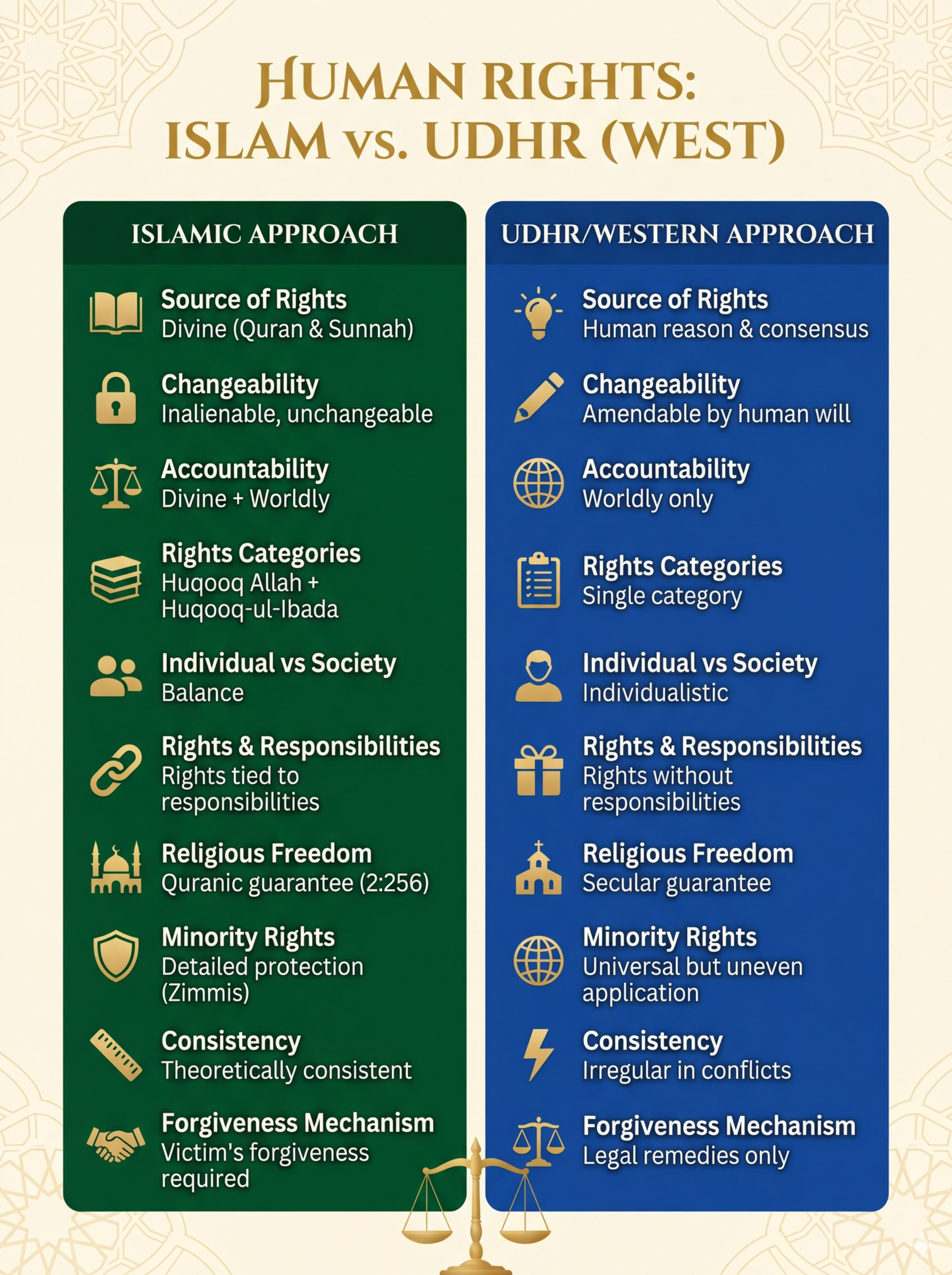
Part V: Comparative Summary Chart
Part VI: Critical Analysis and Conclusions
Strengths of Islamic Human Rights Framework
| Strength | Analysis |
|---|---|
| Divine Source | Rights are inalienable and cannot be amended by transient majorities |
| Comprehensive Accountability | Dual accountability (worldly and divine) creates stronger compliance |
| Rights with Responsibilities | Every right is balanced with corresponding duties |
| Historical Consistency | Principles established 1,400 years ago remain unchanged |
| Minority Protection | Detailed, enforceable protections for religious minorities |
| Community Balance | Individual rights balanced against social good |
Strengths of UDHR/Western Human Rights Framework
| Strength | Analysis |
|---|---|
| Universal Framework | Accepted internationally across diverse cultures |
| Adaptability | Can evolve with changing social circumstances |
| Enforcement Mechanisms | International courts and pressure systems |
| Secular Neutrality | Does not require religious adherence |
| Individual Liberty | Strong protections for personal autonomy |
Critical Weaknesses of Western Human Rights
| Weakness | Evidence from Content |
|---|---|
| Irregular Application | “Implementation of the regularity of human rights in western countries is failing” — Holocaust, Vietnam, Iraq, Bosnia |
| Individualism | “Preferences towards self-motives are higher in the west as western people easily sacrifice family and social rights” |
| Rights Without Responsibilities | “People have many human rights in the west, but they do not have responsibilities” |
| Short-Term Thinking | “They have given people the right to alcohol, but they do not think that an alcoholic person can cause heavy damage” |
| Amendability | Rights change with political power (LGBTQ, abortion amendments) |
Critical Weaknesses of Islamic Human Rights Framework
| Weakness | Analysis |
|---|---|
| Implementation Gap | Modern Muslim states often fail to uphold Islamic human rights standards |
| Interpretation Differences | Diverse schools of thought create inconsistent application |
| Non-Muslim Critiques | Jizya and certain provisions criticized as discriminatory |
| Limited Adaptability | Inalienability can conflict with evolving social needs |
Part V: Final Conclusion
The human rights frameworks of Islam and the Universal Declaration of Human Rights represent two distinct paradigms:
Islamic Paradigm
- Divinely ordained and therefore inalienable
- Rights balanced with responsibilities
- Dual accountability (worldly and divine)
- Comprehensive (covers spiritual, social, economic, political dimensions)
- Historically consistent for over 1,400 years
Western/UDHR Paradigm
- Humanly constructed and therefore amendable
- Individual-centric with fewer social responsibilities
- Worldly accountability only
- Secular (separates religion from state)
- Evolving with changing social norms
Critical Insight
The answer highlights a fundamental distinction:
“The rights in Islam are divine and no one can amend them or take them away from others. These rights are inalienable and bestowed upon humans in the Quran.”
This contrasts with the Western approach where:
“While the laws are made by humans, they are also amendable by them. Everyone who has enough support can amend the law.”
The Question of Application
Both systems face challenges in implementation:
- Islamic system suffers from modern Muslim states failing to uphold its principles
- Western system suffers from irregular application, especially in conflicts and wars
As noted: “Western countries and people do not follow human rights in conflicts, wars, and in freedom of expression.”
The Way Forward
A critical analysis suggests that while the UDHR provides a valuable universal framework, the Islamic human rights tradition offers:
- Stronger accountability mechanisms (divine sanction)
- Better balance between individual and community
- Rights tied to responsibilities
- Historical precedent for multicultural coexistence
The ideal may lie in learning from both traditions—the inalienable, responsibility-based framework of Islam combined with the universal, enforceable mechanisms of modern international human rights law.