Accountability is an assurance that an individual is evaluated on his actions related to something for which he is responsible. In Islam, the higher the status of a person, the more severe the accountability will be. For example, a person who does not have any knowledge or wealth to help others will have lesser responsibility and accountability as compared to a person having a good amount of knowledge and wealth. The same accountability is applied to rulers as well.
“O, my people! Give full measure and weigh with justice. Do not defraud people of their property, nor go about spreading corruption in the land.” — [Surah Hud: 11:85]
This verse establishes the foundational principle that justice and accountability are inseparable in Islam.
Islamic Teachings on the Accountability of Rulers
Core Principle
A ruler will be answerable to Allah if he enjoys the best of comfort and luxury while his nation and followers suffer hunger, death, and oppression.
Hadith on Rulers’ Accountability
“Any man whom Allah has given the authority of ruling some people and he does not honestly look after them will never feel even the smell of paradise.” — [Hadith]
This hadith establishes that rulership is a trust (Amanah) and failure to fulfill this trust has severe consequences in the Hereafter.
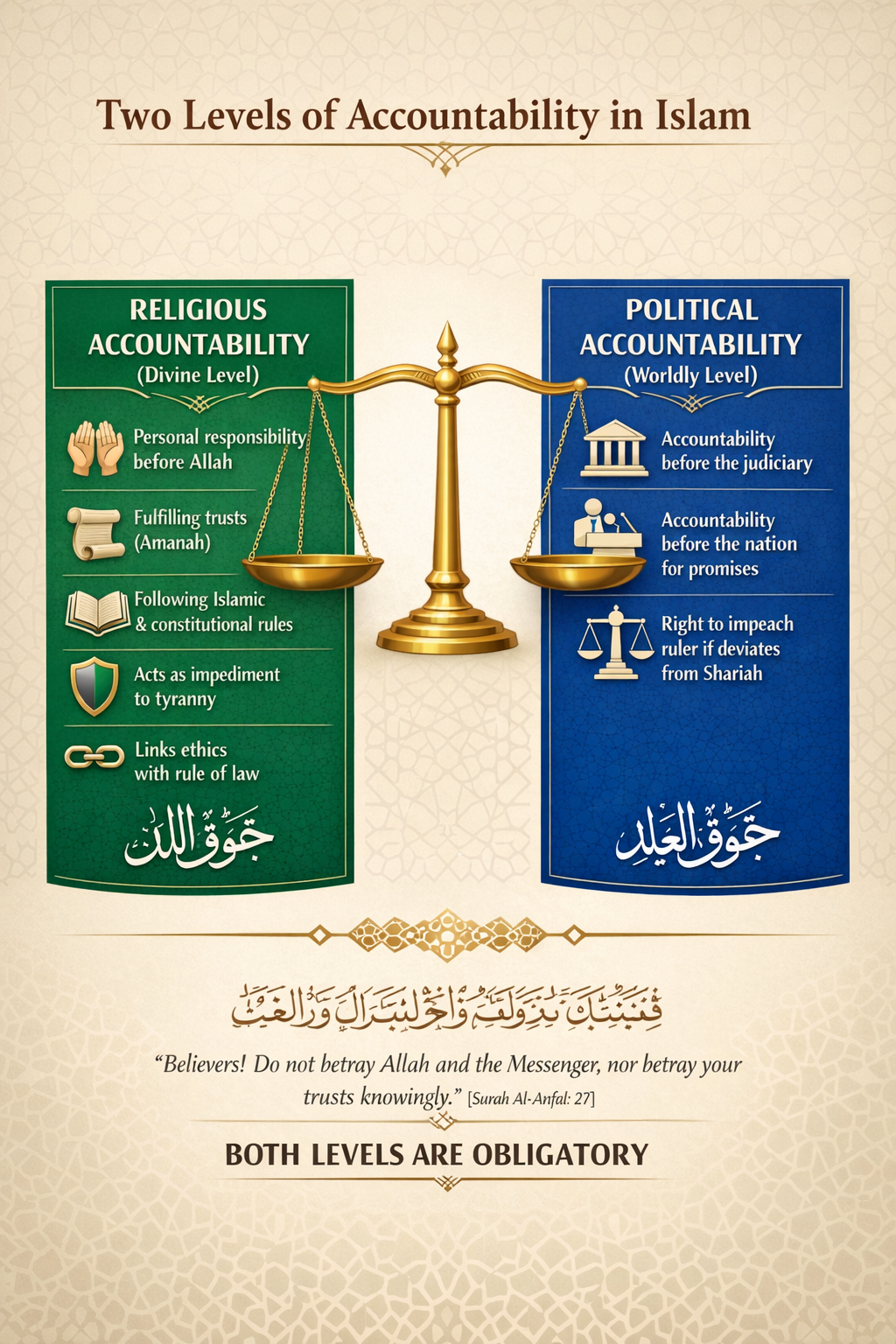
Two Levels of Ruler’s Accountability
The Rashidun Caliphs: Highest Standard of Accountability
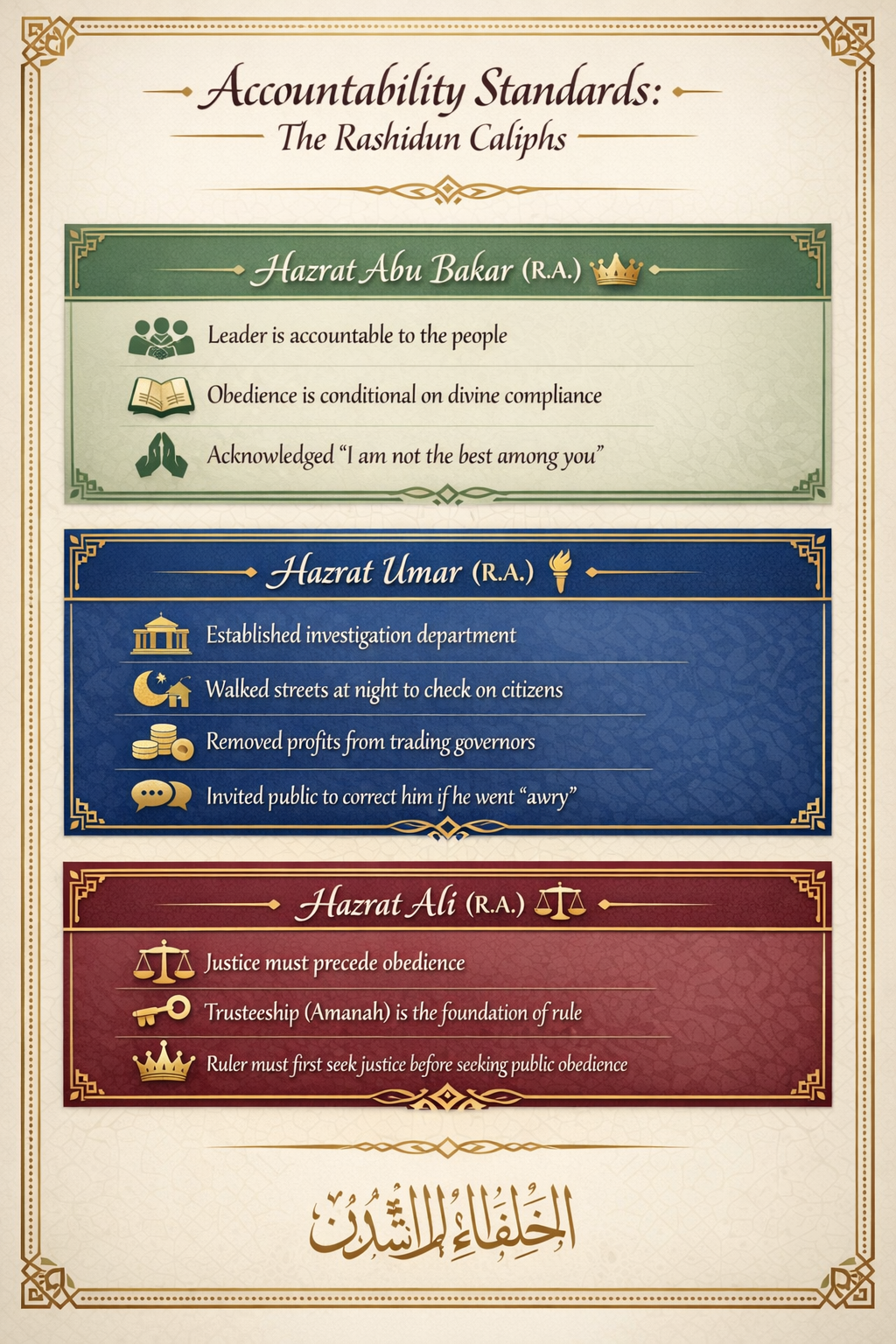
Hazrat Abu Bakar (R.A.) – The First Caliph
After being elected as the first caliph, Hazrat Abu Bakar (R.A.) delivered a historic speech that established the principles of accountability for all future Islamic rulers:
“O people, you choose me to govern you and you must know that I am not the best among you. So, if you believe I am right, you must help me, but as soon as you believe that I am wrong, you must correct me. Obey me until I obey Allah in ruling and conducting your affairs. If you believe that I disobey Allah, you must cease to obey me.” — Hazrat Abu Bakar (R.A.)
Hazrat Umar (R.A.) – The Second Caliph
Hazrat Umar (R.A.) exemplified accountability in both theory and practice. His governance system institutionalized accountability at every level.
Key Accountability Systems Established by Hazrat Umar
System
Description
Special Investigation Department
Established a department for investigating complaints against government officials
Open Complaints Mechanism
Complaints could be made against any officer without fear of repercussions
No Nepotism or Bribery
Nepotism and bribery were unknown during his rule
Restriction on Officials
Officials were not allowed to benefit from business dealings while in power
Night Patrols
Walked the streets of Madina at night to check on the needs of his people
Hazrat Umar’s Statement on Accountability
“O people, whoever of you sees me go awry or crooked, he must correct and set it right.” — Hazrat Umar (R.A.)
Illustrative Examples of Accountability
Example 1: The Woman and Her Starving Children
While roaming the streets of Madina at night, Hazrat Umar heard the voice of a woman who was not able to feed her children and complained bitterly about the Emir. He helped her by bringing food on his own shoulders and said:
“It is my negligence towards my people.”
┌─────────────────────────────────────────────────────────────────────────────────────┐
│                   EXAMPLE: HAZRAT UMAR'S PERSONAL ACCOUNTABILITY                    │
├─────────────────────────────────────────────────────────────────────────────────────┤
│                                                                                      │
│   Situation: A woman unable to feed her children complains bitterly about the Emir  │
│                                                                                      │
│   Hazrat Umar's Response:                                                            │
│   ┌─────────────────────────────────────────────────────────────────────────────┐   │
│   │ • Personally carried food on his shoulders to her home                     │   │
│   │ • Acknowledged his own negligence: "It is my negligence towards my people" │   │
│   │ • Took immediate action to address the suffering                           │   │
│   └─────────────────────────────────────────────────────────────────────────────┘   │
│                                                                                      │
│   Lesson: A ruler is personally responsible for the welfare of every citizen,       │
│           especially the most vulnerable.                                            │
│                                                                                      │
└─────────────────────────────────────────────────────────────────────────────────────┘
Example 2: The Governor Who Engaged in Trade
Someone reported that one of his governors, Al-Harith ibn K’ab ibn Wahab, had extra money beyond his salary. Hazrat Umar inquired about this, and Al-Harith replied that he had some money that he used for trading.
To this, Hazrat Umar responded:
“By Allah, we did not send you to engage in trade!”
He then took away the profits from him and added them to the treasury of Muslims.
┌─────────────────────────────────────────────────────────────────────────────────────┐
│              EXAMPLE: ACCOUNTABILITY OF GOVERNORS BY HAZRAT UMAR                    │
├─────────────────────────────────────────────────────────────────────────────────────┤
│                                                                                      │
│   Issue: Governor Al-Harith had extra money beyond his salary                        │
│                                                                                      │
│   Investigation:                                                                     │
│   ┌─────────────────────────────────────────────────────────────────────────────┐   │
│   │ • Hazrat Umar personally inquired about the excess money                    │   │
│   │ • Governor explained he used his own money for trading                      │   │
│   │ • Hazrat Umar ruled: "By Allah, we did not send you to engage in trade!"   │   │
│   └─────────────────────────────────────────────────────────────────────────────┘   │
│                                                                                      │
│   Outcome: Profits confiscated and added to Bait-ul-Mal (Public Treasury)           │
│                                                                                      │
│   Lesson: Public officials cannot use their position to gain personal wealth;       │
│           all resources belong to the public trust.                                  │
│                                                                                      │
└─────────────────────────────────────────────────────────────────────────────────────┘
Hazrat Ali (R.A.) – The Fourth Caliph
Hazrat Ali (R.A.) further articulated the principles of accountability, emphasizing the mutual relationship between the ruler and the ruled:
“The caliph must rule with justice and perform the trusteeship. If he did so, Muslims must obey him because the caliph must first seek justice and trust in his rule before asking for the public’s obedience.” — Hazrat Ali (R.A.)
This statement establishes that:
Justice precedes obedience – The ruler must first establish justice before demanding obedience
Trusteeship is foundational – Rulership is a trust, not a privilege
Accountability is mutual – Both ruler and ruled have obligations
Comparative Summary: Accountability Standards of Rashidun Caliphs
Key Accountability Systems Established by the Rashidun Caliphs
System
Established By
Description
Conditional Obedience
Hazrat Abu Bakar
Obedience to ruler only until he obeys Allah
Investigation Department
Hazrat Umar
Special department for complaints against officials
Open Complaints Mechanism
Hazrat Umar
Citizens could complain without fear
Restriction on Officials’ Trade
Hazrat Umar
Officials prohibited from using position for personal gain
Night Patrols
Hazrat Umar
Personal inspection of citizens’ welfare
Judicial Independence
Hazrat Umar
Judiciary could hold anyone accountable, even the ruler
Justice Precedes Obedience
Hazrat Ali
Ruler must establish justice before demanding obedience
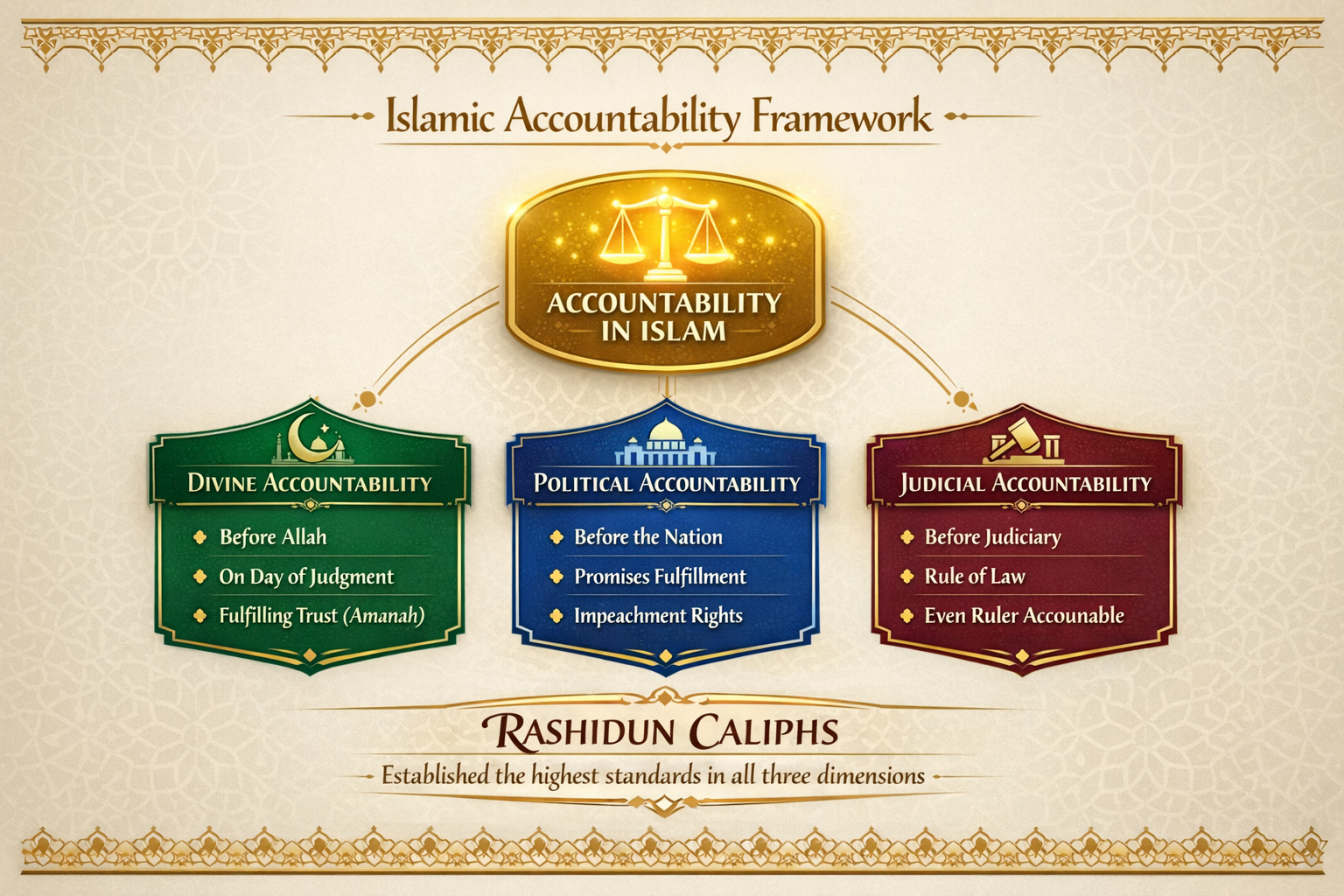
The Islamic Accountability Framework: A Visual Model
Lessons for Modern Governance
The practices of the Rashidun Caliphs offer timeless principles:
Principle
Application
Leaders are accountable
No one is above the law, including the ruler
Obedience is conditional
Citizens must obey only when rulers follow divine law
Open complaint mechanisms
Citizens should be able to report grievances without fear
Restrictions on officials
Public office should not be used for personal enrichment
Personal responsibility
Rulers must personally ensure welfare of all citizens
Justice precedes obedience
Rule must be based on justice before demanding loyalty
Conclusion
The concept of accountability in the Islamic system is comprehensive and multi-layered, encompassing both religious accountability before Allah and political accountability before the nation and judiciary. The higher the status of a person, the more severe the accountability—a principle that applies most strictly to rulers.
The Rashidun Caliphs set the highest standard in this perspective:
Hazrat Abu Bakar (R.A.) established the principle that obedience to rulers is conditional upon their obedience to Allah, and that citizens have the right to correct their leaders.
Hazrat Umar (R.A.) institutionalized accountability through investigation departments, open complaint mechanisms, restrictions on officials, and personal oversight of citizens’ welfare. His famous response—“By Allah, we did not send you to engage in trade!”—demonstrates the uncompromising standard of accountability he maintained.
Hazrat Ali (R.A.) emphasized that justice must precede obedience, establishing that rulership is a trusteeship (Amanah) that must be fulfilled before demanding loyalty.
These practices, rooted in Quranic teachings and Prophetic guidance, created a governance system where no one was above the law, where leaders were accessible to the weakest citizens, and where accountability was institutionalized rather than left to individual conscience. This remains the gold standard of accountable governance in Islamic political thought.