Introduction
Civilizations have never existed in isolation. Through centuries of conflict, waves of refugees, and the relentless tide of globalization, ideas and technologies have crossed every border. The Islamic civilization and Western civilization are no exception. Western civilization has impacted Islamic civilization significantly in multiple ways. The current dynamics of society—democracy, capitalism, feminism, the banking system, and technological advancements—bear the marks of this influence. Some of these changes have brought progress. Others have brought a quiet erosion of values that once held Muslim societies together. Therefore, some steps are needed to counter the repercussions of Western culture in order to protect Muslim societies.
Manifestation of Negative Influence on Islamic Civilization
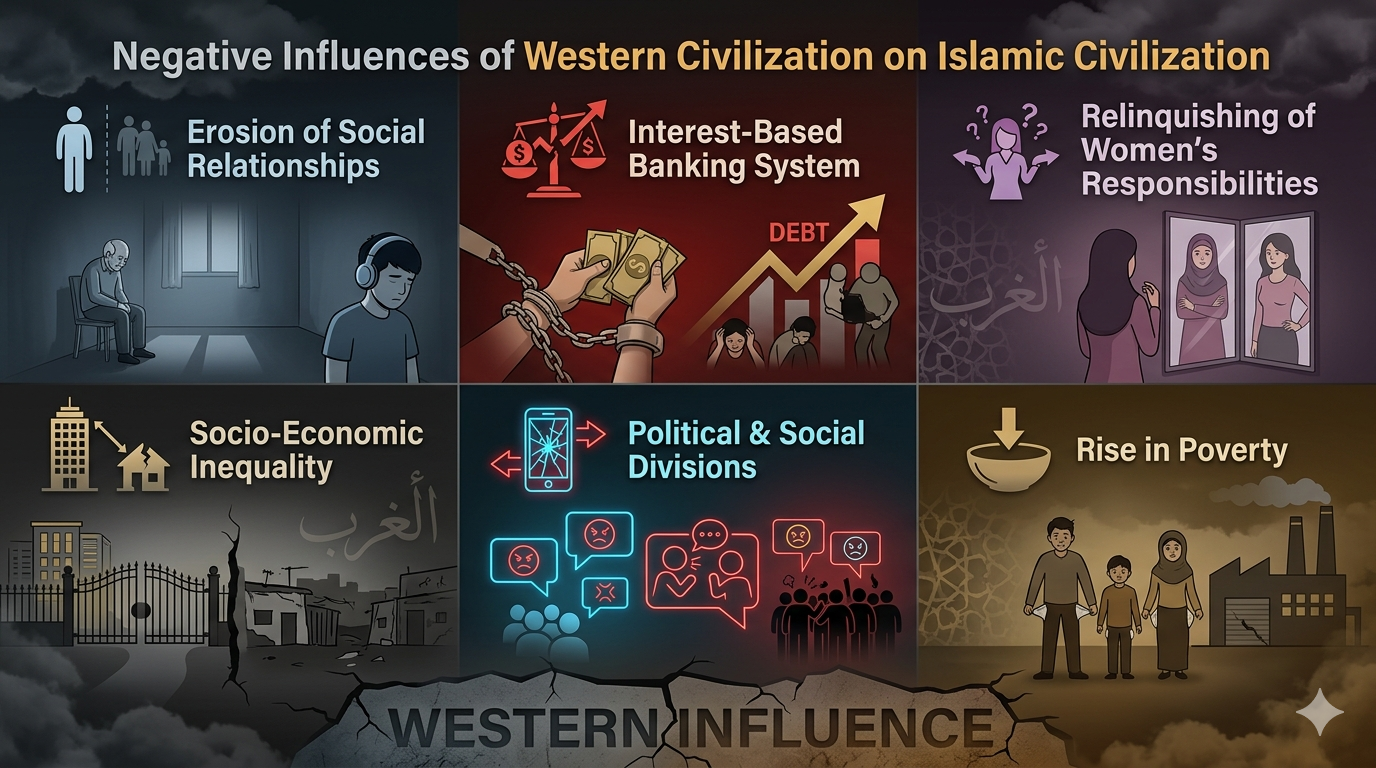
1. Erosion of Social Relationships by Embracing Individualism
There is something beautiful about the way traditional Muslim societies were structured. The family was not just a unit—it was a universe. Grandparents lived with grandchildren. Cousins grew up as siblings. Neighbors knew each other’s names, struggles, and joys. The community was an extension of the self.
Western individualism has changed this. The idea that the individual is the highest unit of society—that personal freedom matters more than collective responsibility—has slowly seeped into Muslim societies. Young people now speak of “finding themselves” in ways that would have puzzled their grandparents. Elderly parents sit in empty homes while their children pursue careers in distant cities. The concept of “me time” has replaced the concept of “we time.”
2. Interest-Based System in the Banking Sector
For centuries, Islamic finance operated on principles that prohibited interest (riba). Money was not supposed to make money on its own. Wealth was supposed to be generated through trade, risk-sharing, and productive enterprise.
The Western banking system, built on interest, has become the global standard. Muslim countries, in their rush to modernize, adopted this system almost wholesale. Today, Islamic banking exists as a niche—often trying to replicate conventional products while finding creative ways to label them “Shariah-compliant.” The result is a hybrid system that satisfies neither the demands of global finance nor the principles of Islamic economics.
3. Feminism Influence in Relinquishing Responsibility of Women
Islam gave women rights 1,400 years ago that Western women would not see for centuries. The right to own property. The right to inherit. The right to divorce. The right to education. These were not Western imports—they were Islamic revelations.
But Western feminism has brought something different. Not just equality—which Islam affirms in spiritual worth and accountability—but a particular kind of sameness that often demands women relinquish their distinct responsibilities without acknowledging their distinct rights. When Muslim societies uncritically adopt Western feminist frameworks, they often end up with the worst of both worlds: women lose the protections and honor that Islamic law provided, without gaining the full empowerment that Western feminism promises.
4. Socio-Economic Inequality
Capitalism, in its Western form, has produced extraordinary wealth. It has also produced extraordinary inequality. The gap between the rich and the poor in Muslim societies has widened dramatically in recent decades. In traditional Islamic economics, wealth was supposed to circulate. Zakat was a floor, not a ceiling. The rich were not villains, but they were trustees, not owners. Today, in many Muslim societies, the rich live in gated communities while the poor live in slums.
5. Increasing Political and Social Divisions Due to Promotion of Different Ideologies on Technology
Technology was supposed to unite us. Instead, it has divided us. Social media platforms, designed in Silicon Valley, have algorithms that reward outrage over nuance, division over dialogue, and tribalism over truth. Muslim societies, once known for their relative social cohesion, are now fractured along political, sectarian, and ideological lines. The same platforms that enable activism for justice also enable the spread of hatred.
6. Rise in Poverty
For all the talk of economic growth, poverty has risen in many Muslim societies. This is not because Islamic civilization is poor in resources—it is because the economic models adopted from the West have failed to distribute those resources justly. Structural adjustment programs, imposed by Western institutions, have cut social safety nets. Free trade agreements have favored multinational corporations over local producers.
Countering the Negative Influence: Measures to Protect Muslim Societies
1. Zakat as an Antidote to Poverty Alleviation
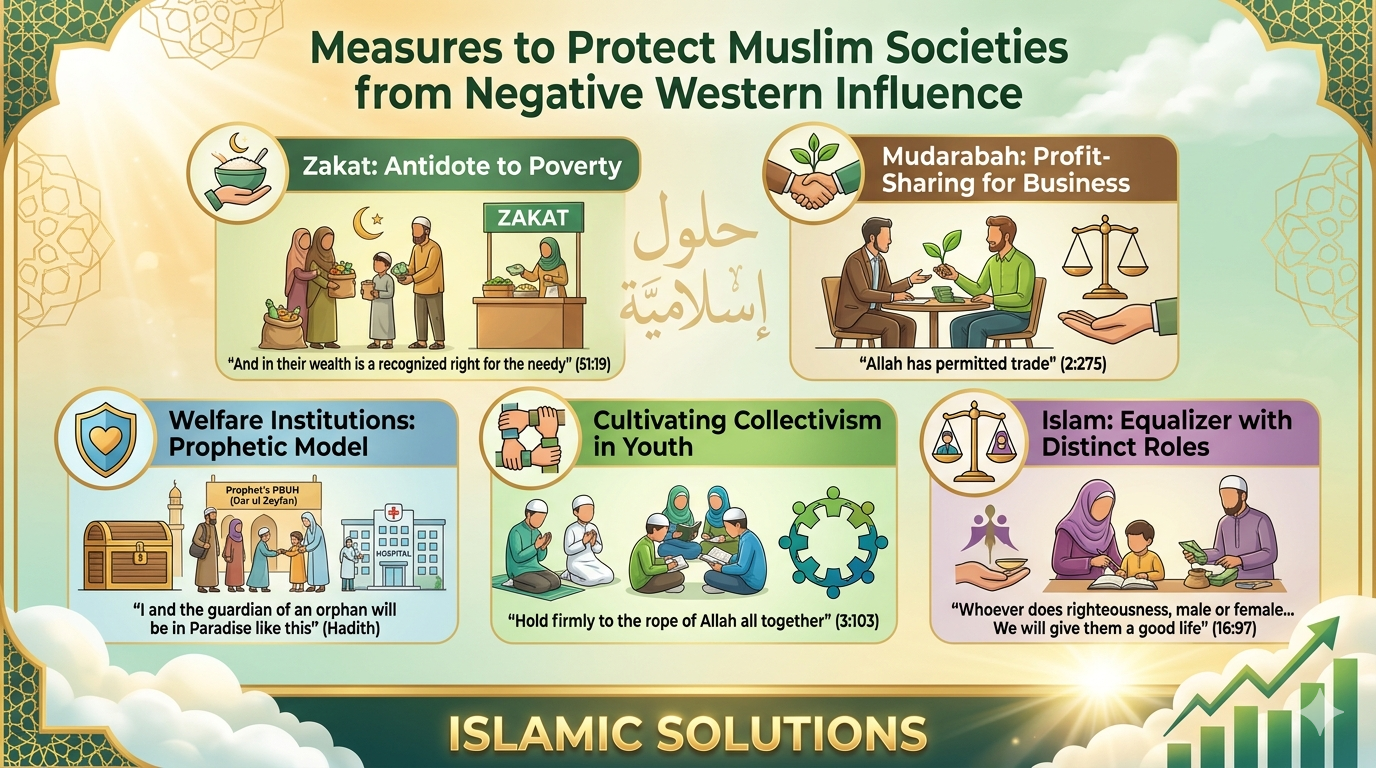
Long before the World Bank spoke of “social safety nets,” Islam had Zakat. This is not charity—it is an obligation. It is not voluntary giving—it is a right that the poor have over the wealth of the rich. The Quran is explicit: “And in their wealth is a recognized right for the needy and the deprived.” (51:19)
Zakat, if properly collected and distributed, could eradicate poverty in Muslim societies. Muslim states need to professionalize Zakat collection, ensure transparency in distribution, and prioritize the poorest of the poor.
2. Mudarabah as a Modern Solution to Promote Startups and Business
The Western financial system is built on debt. You borrow money, you pay interest, you return the principal. Islamic finance offers an alternative: Mudarabah, or profit-sharing. An investor provides capital, an entrepreneur provides expertise, and both share the profits—and the losses.
This model aligns the interests of investors and entrepreneurs. It encourages risk-taking without predatory lending. It rewards success without punishing failure with crippling debt. Muslim societies should champion Mudarabah as a superior alternative to interest-based financing.
“O you who believe! Do not consume one another’s wealth unjustly, but only [in lawful] business by mutual consent.” — [Surah An-Nisa: 4:29]
This verse emphasizes that wealth must be generated through mutual consent and legitimate business—exactly what Mudarabah (profit-sharing) achieves
3. Foundation of Welfare Institutions to Absorb Shock of Global Economic Crisis
The 2008 financial crisis revealed something ugly about Western capitalism: when the system crashes, the poor are hurt first and worst. Muslim societies need their own welfare institutions—not as charity, but as structural buffers against global economic shocks.
Examples of Welfare Institutions During the Reign of the Holy Prophet (PBUH):
| Institution | Description |
|---|---|
| Bait-ul-Mal (Public Treasury) | Established by the Prophet PBUH in Madinah as a state treasury to collect and distribute wealth among the needy, widows, orphans, and the poor. It functioned as a comprehensive welfare system. |
| Guest Houses (Dar ul Zeyfan) | The Prophet PBUH set up guest houses for travelers, delegates, and visitors, providing them food, shelter, and proper care without charge. |
| Support for Widows and Orphans | The Prophet PBUH said, “I and the person who looks after an orphan will be together in Paradise like this” (holding his two fingers together). This encouraged the community to establish welfare mechanisms for the most vulnerable. |
| State Support for the Needy | The Prophet PBUH ensured that Zakat and Sadaqat were systematically collected and distributed to the poor, the disabled, and those in debt. No one in the Islamic state was left without basic necessities. |
| Free Healthcare | The Prophet PBUH established medical facilities and encouraged treatment for the sick, with the state bearing the expenses for those who could not afford it. |
These institutions were not charities—they were structural rights. A society that can weather economic storms without abandoning its values is a society that has learned from the West without being consumed by it.
4. Cultivating Collectivism in Youth to Counter Isolationism and Depression
The West has a loneliness epidemic. Despite—or perhaps because of—its individualism, rates of depression, anxiety, and suicide have climbed. Muslim societies are not immune. As young people adopt Western notions of “independence,” they often find themselves isolated, anxious, and unmoored.
The solution is not to reject modernity but to reclaim community. Mosques, youth groups, extended family networks, and neighborhood associations must be revived. Young Muslims need to feel that they belong to something larger than themselves.
“And hold firmly to the rope of Allah all together and do not become divided.” — [Surah Al-Imran: 3:103]
This verse commands Muslims to hold firmly to the rope of Allah—collectively, as one community. It is a direct instruction against the individualism and fragmentation that Western influence has exacerbated. When young Muslims understand that their strength lies in unity, in holding the rope of Allah together, they find protection against the isolation and depression that come from going it alone.
5. Promoting Islam as an Equalizer for Men and Women by Giving Them Different Social Roles
Western feminism has fought for equality by demanding sameness. Islam offers a different vision: equality in worth, dignity, and spiritual standing, but with distinct social roles that honor the unique strengths and responsibilities of men and women.
Muslim societies must reclaim this narrative. They must teach their youth that Islam does not oppress women—it protects them. It does not diminish them—it honors them. And it does not trap them in roles—it liberates them from the exhausting expectation that they must do everything, be everything, and sacrifice everything to prove their worth.
Islam recognizes that men and women have different strengths and responsibilities. As Allah says: “Men are the protectors and maintainers of women, because Allah has given one more (strength) than the other, and because they support them from their means.” [4:34] This is not oppression—it is a balanced division of labor that honors both.
A Balanced Comparison: Western vs. Islamic Approaches
| Domain | Western Approach | Islamic Alternative |
|---|---|---|
| Social Structure | Individualism (self-focused) | Collectivism (community-focused) |
| Banking | Interest-based (riba) | Profit-sharing (Mudarabah) |
| Poverty Alleviation | Welfare state (tax-funded) | Zakat (obligatory charity) |
| Welfare Institutions | Modern social safety nets | Bait-ul-Mal, Guest Houses, Orphan support |
| Community Cohesion | Fragmented | “Hold firmly to the rope of Allah” (3:103) |
| Gender Roles | Sameness as equality | Distinct roles, equal worth |
Conclusion
Western civilization has influenced Islamic civilization profoundly. Democracy, capitalism, feminism, modern banking, and digital technology have reshaped Muslim societies in ways both positive and negative. The challenge is not to build a wall against the West—that would be impossible and unwise. The challenge is to absorb what is beneficial, reject what is harmful, and remain rooted in Islamic values while engaging with the modern world.
Islam provides the antidotes: Zakat for poverty, Mudarabah for ethical finance, welfare institutions inspired by the Prophet’s PBUH example, collectivism rooted in the command to “hold firmly to the rope of Allah,” and a balanced vision of gender that honors both men and women.
Muslim societies do not need to choose between tradition and modernity. They need to choose between being passive recipients of Western influence and active architects of their own future. The tools are there. The values are there. What remains is the will.