Introduction
Imagine you are part of a community facing a problem that the Quran and Sunnah have not directly addressed. What do you do? You gather the wisest, most knowledgeable people among you. You discuss, you deliberate, and you agree on a solution together. That, in essence, is Ijma.
In linguistic terms, Ijma means to resolve and agree. In Islamic law, it refers to the agreement of qualified jurists (mujtahids) after the Prophet’s death on a Shariah ruling. Muslims regard Ijma as the third source of Sharia law, after the Qur’an and the Sunnah.
“My Ummah will not unanimously agree on misguidance.” — [Hadith]
This single saying of the Prophet (PBUH) gives Ijma its power. If the community cannot collectively agree on error, then their agreement must be upon truth.
Important: The opposite of Ijma is Ikhtilaf (lack of consensus). Ijma cannot change fundamental rituals and worship—it operates within the boundaries set by the Quran and Sunnah.
What Muslim Scholars Say
| Scholar | Definition |
|---|---|
| Abul Huseyn al-Basri | “Agreement of a group on a certain matter by action or abandonment.” |
| Imam Al-Ghazali | “Agreement of the community of Muhammad on a religious point.” |
Why Do We Need Ijma?
When the Prophet (PBUH) passed away, the original law-making process ended. But life didn’t stop. New problems emerged—issues the Quran and Sunnah hadn’t directly addressed.
Ijma fills the gap.
It authenticates the correct interpretation of the Quran and Sunnah. Without it, Islamic law would be incomplete and unable to address changing times.
Only Mujtahids (qualified jurists) can participate in Ijma—not every Muslim.
Proof from Quran and Sunnah
Quranic Evidence
| Verse | Message |
|---|---|
| “Had they referred it to the Messenger or their authorities, those with sound judgment among them would have validated it.” [4:83] | Collective reasoning of qualified individuals has value |
| “And follow the way of those who turn to Me in devotion.” [31:15] | Following the collective agreement of the righteous is encouraged |
Hadith Evidence
“My Ummah will not unanimously agree on misguidance.”
Once a valid Ijma is formed, it becomes binding—equal in authority to Quranic verses on that specific matter.
Types of Ijma
Whose Opinion Matters in Ijma?
| Type | Description | Authority Level |
|---|---|---|
| Ijma of Companions | Consensus of Prophet’s companions | Most authoritative |
| Ijma of Jurists | Unanimous decision of jurists (non-companions) | Highly authoritative |
| Ijma of Scholars | Majority opinion of Muslim scholars | Accepted as law |
| Ijma of People/Masses | Opinion of majority of Muslims | Little value |
| Ijma of People of Madina | Consensus of companions & successors in Madina | Recognized by some schools |
| Ijma of Ahl-i-Bayt | Consensus of Prophet’s family (Shia view) | Binding for Shia Muslims |
Conditions for Valid Ijma
For an Ijma to be valid and binding, the following conditions must be met:
| Condition | Explanation |
|---|---|
| Done by Mujtahids only | Scholars who are pious, fear Allah, and have attained Ijtihad status |
| Unanimous opinion | All mujtahids must agree; no well-known difference of opinion |
| After Prophet’s death | Ijma can only be formed after the passing of the Prophet (PBUH) |
| Same generation | Jurists must be from a single determined period |
| Based on evidence (Sanad) | Opinions must derive from Quran and Sunnah, not personal whims |
Examples from the Life of Prophet (PBUH) and Companions
Example 1: Battle of Uhud
The Prophet (PBUH) consulted his companions about whether to fight inside or outside Madina. He agreed to their consensus to fight outside—even though his personal opinion leaned otherwise.
Example 2: Battle of the Trench
The idea of digging a trench around Madina came from Salman Farsi (R.A.). The Prophet (PBUH) accepted the consensus of his companions and implemented it.
Example 3: Compilation of the Quran (Hazrat Abu Bakr)
After the Battle of Yamama, where many Quran memorizers were martyred, Hazrat Abu Bakr (R.A.) consulted the companions and formed an Ijma to compile the Quran into a single book.
Example 4: Two Azaans on Friday (Hazrat Uthman)
When cities became crowded and people could not hear the Azaan, Hazrat Uthman (R.A.) introduced a second Azaan for Friday prayers based on the consensus of the companions.
Importance of Ijma in Light of Quran and Sunnah
| Aspect | Importance |
|---|---|
| Continuity | Keeps Islamic law alive and relevant after revelation ended |
| Unity | Prevents fragmentation of the Ummah on legal matters |
| Authenticity | Protects correct interpretation of Quran and Sunnah |
| Flexibility | Allows Islam to address new problems without changing core principles |
| Collective Wisdom | Values community over individual opinion |
Contemporary Relevance of Ijma

In our modern world, Ijma is more relevant than ever. Consider these contemporary applications:
1. Bioethics and Medical Issues
- Organ transplantation
- IVF and assisted reproduction
- End-of-life care
- Genetic engineering
Muslim jurists worldwide have formed Ijma on many of these issues, providing guidance where the Quran and Sunnah are silent.
2. Islamic Finance
- Cryptocurrency and digital assets
- Modern banking practices
- Takaful (Islamic insurance)
Ijma has played a crucial role in developing modern Islamic financial products.
3. Technology and Social Media
- Rulings on social media usage
- Digital privacy in Islam
- Online transactions and contracts
4. Contemporary Political Issues
- Democracy and governance in Muslim societies
- Citizenship and minority rights
- International relations
5. Environmental Ethics
- Climate change and Islamic responsibility
- Conservation and sustainability
Conclusion
Ijma is not a relic of the past. It is a living, breathing tool that keeps Islamic law relevant, flexible, and unified. From the companions of the Prophet who compiled the Quran to the modern jurists debating cryptocurrency, Ijma has been the thread connecting generations of Muslims to their faith.
The Prophet (PBUH) promised that his Ummah would never agree on misguidance. That promise is not just a comfort—it is a responsibility. It calls us to deliberate, to consult, and to seek consensus. It reminds us that while the Quran and Sunnah are complete, our understanding of them is a shared journey.
In a world of division and discord, Ijma offers something precious: unity. And that is perhaps its greatest gift.
This guide explores Ijma (consensus) as the third source of Islamic law—its definition, types, importance, and why it matters for Muslims living in the modern world.
Quick Summary
| Element | Summary |
|---|---|
| Definition | Agreement of qualified jurists on a Shariah ruling after Prophet’s death |
| Source Rank | 3rd source after Quran and Sunnah |
| Proof | “My Ummah will not agree on misguidance” (Hadith) |
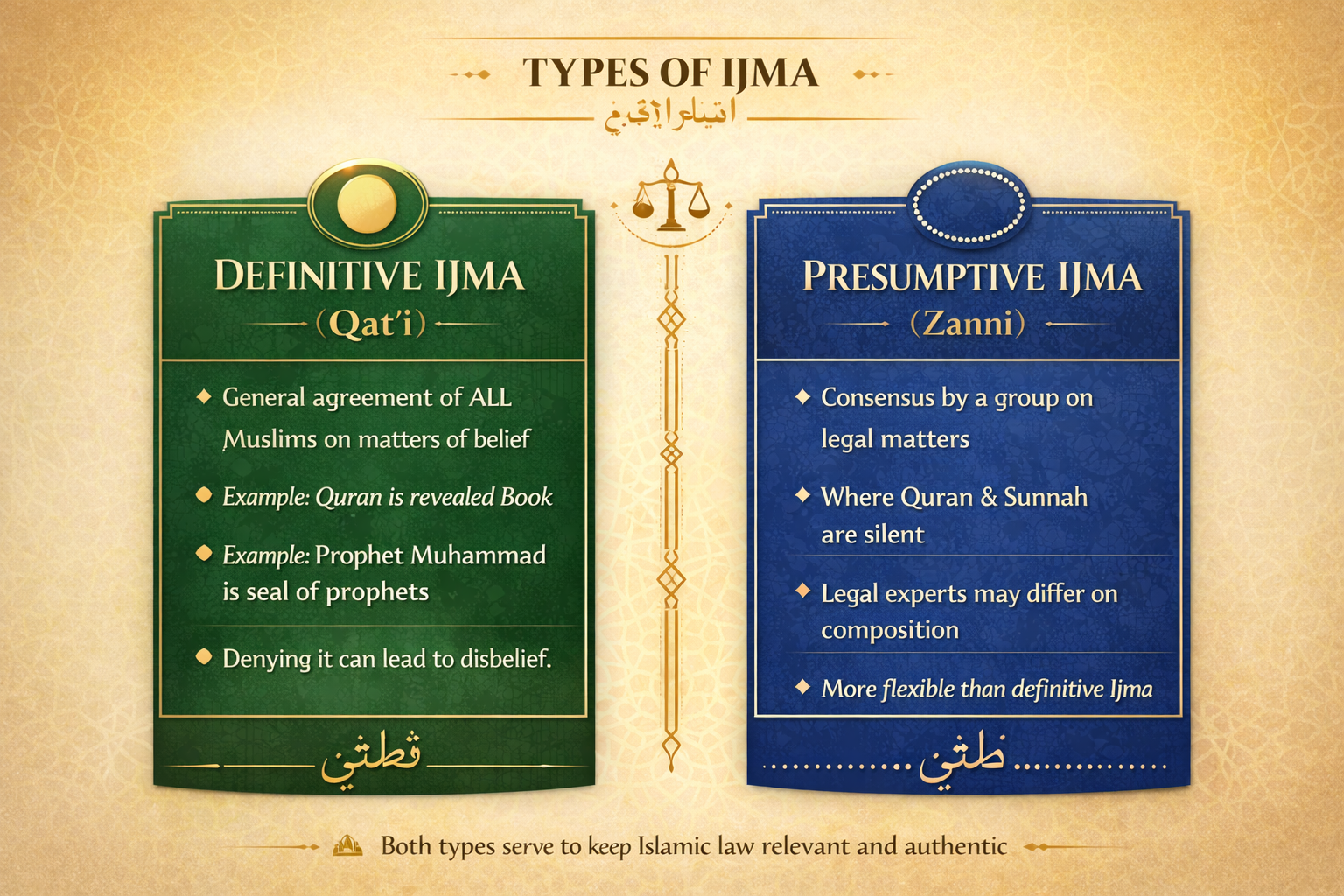
| Types | Definitive (Qat’i) and Presumptive (Zanni) |
| Key Condition | Only mujtahids can participate; must be unanimous |
| Examples | Compilation of Quran, two Azaans on Friday |
| Contemporary Role | Bioethics, finance, technology, environment |